
For 28 years, our work has revolved around the three pillars of conservation, restoration, and education. Although our specific projects have evolved over the years, our approach remains the same: to work in partnership with First Nations and environmental groups to promote systemic changes to the ways we make use of marine resources. We’re dedicated to protecting coastal ecosystems now and into the future.
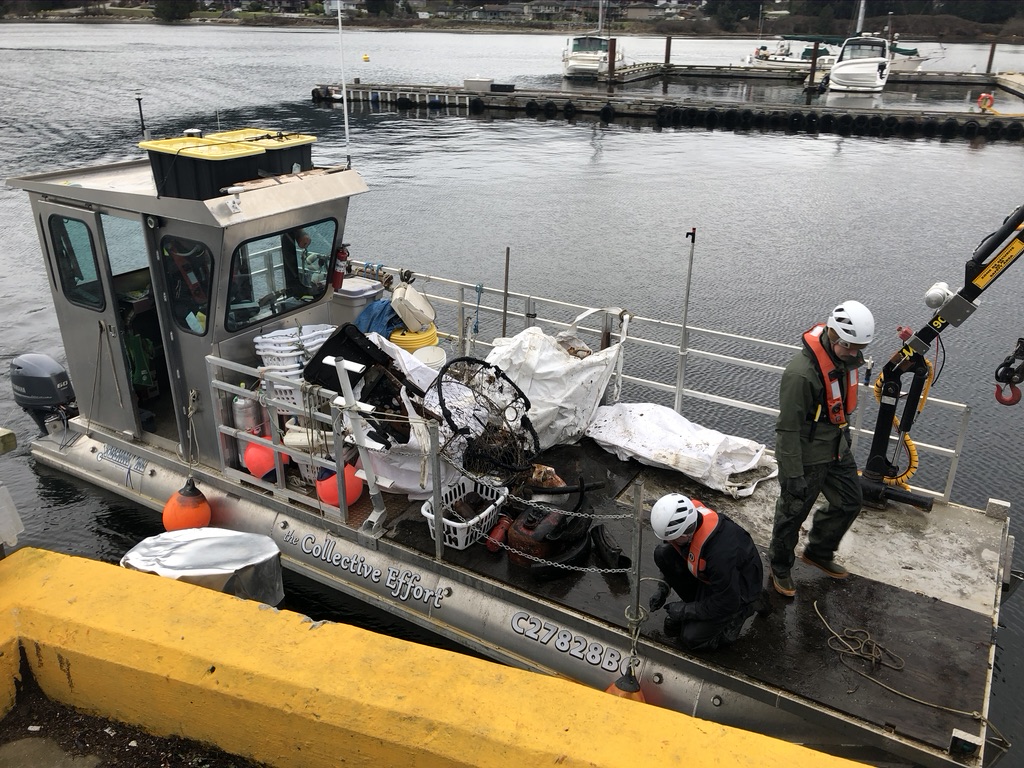
Over the decades, our conservation programs have included everything from eelgrass mapping and monitoring to removing fishing gear from hot spots around the Salish Sea with the same goal: to conserve nearshore ecosystems and support local conservation policies and practices.
From our earliest days, our education programs have centred on applying marine science to real-life experiences for youth. Our EcoRowing and Paddling program took students from local schools out onto the peaceful waters of SṈIDȻEȽ (The Place of the Blue Grouse) and along the shorelines to learn about hunting and fishing from a Tsartlip First Nations member and the ecosystem of the watershed. We have also hosted international student programs in partnership with the University of Victoria and Vancouver Island University and taught survey training for local volunteers.
Our restoration work took root in 1999 when we restored 1800 eelgrass shoots in Tod Inlet, SṈIDȻEȽ (pronounced sngeet-kwith) with community and government support. Over the years we increased our scope and scale of eelgrass restoration to nearshore marine habitats in four regions: the northern and southern Gulf Islands, Howe Sound and Burrard and Sechelt Inlets.
As we celebrated our 25th anniversary in 2023, we underwent exciting changes, including our acquisition of the ShoreZone program, and the start of a five-year Resilient Estuaries of the Salish Sea initiative. We invite you to explore our current and past projects in more detail below, and get in touch to learn more about our programs and how you can get involved.
Resilient Estuaries of the Salish Sea Initiative (RESS)
If you live near the Salish Sea, you may have seen our boats on the water as our researchers collect water quality and biodiversity data as part of our newest initiative. Over the next several years, our project team aims to identify and restore estuaries that will provide crucial ecological hotspots as the oceans are altered by climate change.
ShoreZone
In 2022, we acquired the ShoreZone mapping and surveying system, along with its specially trained survey team and the program’s entire vast inventory of the biology and geology of North America’s coastlines. Although we have used ShoreZone many times over the decades to help us with our work, having the database and the ShoreZone team in-house allowed us to survey, map and assess the condition of nearshore coastal ecosystems and expand our work far beyond the Salish Sea.
In the spring of 2026, ShoreZone was moved to Archipelago Marine Research Ltd.
SṈIDȻEȽ
The shores and forests of SṈIDȻEȽ were used as a wintering village by the W̱SÁNEĆ First Nations for thousands of years. Marine and land plants and animals, from shellfish to deer and salmon provided sustenance. However, the shores and the inlet’s waters have been heavily impacted by historical industrial activities since the early 1900s. In partnership with Tsartlip First Nations, BC Parks, and other community partners, SeaChange has worked to restore eelgrass and marine riparian sites in this special area.